A new Spanish meteorite: Retuerta del Bullaque (Ciudad Real). Classification, mineralogy and preservation of the morphology
DOI:
https://doi.org/10.3989/egeol.41337.272Keywords:
Iron meteorite, octaedrite, IAB complex (MG), Spain, new meteorite find, preservation of iron meteorites, meteorite replica, meteorite 3D scan imageAbstract
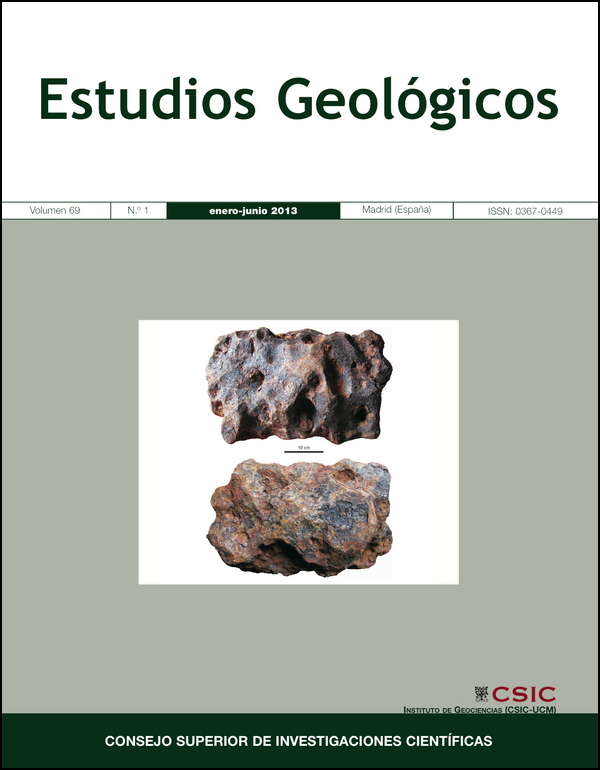
Retuerta del Bullaque is a new Spanish iron meteorite. Found in 1980, has been recovered from the Province of Ciudad Real, near the northern limit of the Cabañeros National Park (39º27’32”N, 4º22’39”W). The specimen is a coarse octahedrite of about 100 kg in weight, with many concave regmaglyphes in one surface and moderate terrestrial weathering. The atmospheric heat-affected rim (≤1.5 mm) is partially preserved. Analysis by ICP-AES (Ni: 7.527 and Co: 0.475 in wt%) and by ICP-MS (Ga: 68.9, Ge: 365, As: 13.7, W: 0.95, Ir: 1.95 and Au: 1.70 in ppm) we used to classify the specimen as an IAB complex (Main Group). Chemically, Retuerta del Bullaque iron is similar to Kaalijarv iron but its mineralogy and texture are more like other low Ni-Au irons of main group (e.g. Diablo Canyon). The bulk of the specimen is a Widmanstätten kamacite (band-width estimated at 2.0 ± 0.3 mm) with large and tabular crystals of cohenite and polygonal kamacite without cohenite that exhibits abundant Neumann lines. Schreibersite (irregular crystals + rhabdite) is rare in the two sectors. Taenite is present in thick lamellae between kamacite bands and pearlitic plessite. Lamellar cohenite is very abundant (9.5% of the total area into two sections 77.7 and 41.1 cm2), is partially covered of schreibersite and contains kamacite-taenite spherules. The larger sections display irregularly shaped troilite-graphite nodules (max. size, 5-12 mm), located in the central areas of the kamacite polygonal sectors. Each nodule has a rim of schreibersite + cohenite. The original morphology of the specimen was preserved making replicas as molds and casts (using elastomers, resins and modified plasters) and a 3D-laser scan.
Downloads
References
Belmonte, S.L.R.; Zucolotto, M.E.; Fontes, R.C. & dos Santos, J.R.L. (2012). 3-D virtual and physical reconstruction of Bendego iron. 75th Annual Meteoritical Society Meeting. Cairns, Australia, 5149.pdf.
Boscá y Casanoves, E. (1899). El meteorito de Quesa (Valencia). Anales de la Sociedad Española de Historia Natural, 28: 53-56.
Brett, R. (1966). Cohenite in meteorites: a proposed origin. Science, 153: 60-62. http://dx.doi.org/10.1126/science.153.3731.60 PMid:17730609
Bunch, T.E.; Keil, K. & Olsen, E. (1970). Mineralogy and petrology of silicate inclusions in iron meteorites. Contributions to Mineralogy and Petrology, 25: 297-340. http://dx.doi.org/10.1007/BF00399290
D'Orazio, M. & Folco, L. (2003). Chemical analysis of iron meteorites by Inductively Coupled Plasma-Mass Spectrometry. Geostandars Newletters, 27-3: 215-225.
D'Orazio, M.; Folco, L.; Welten, K.C.; Caffee, M.W.; Perchiazzi, N. & Rochete, P. (2006). Miller Butte 03002: a new rare iron meteorite (IID) from Antarctica. European Journal of Mineralogy, 18: 727-738. http://dx.doi.org/10.1127/0935-1221/2006/0018-0727
Dorronsoro, J. & Moreno Martín, F. (1934). Sobre un hierro meteórico de la provincia de Granada. Anales de la Sociedad Española de Física y Química, 32: 1111-1115.
García-Guinea, J.; Sanchez-Chillón, B.; Mazo, A.; Tormo, L.; González-Martín, R.; Correcher, V. & Pardillo- Mayora, J.M. (2005). Nuevos datos sobre la escoria de Getafe caída en un vehículo en 1994. Geogaceta, 37: 159-162.
García Guinea, J.; Martín Escorza, C.; Fernández Hernán, M.; Sánchez Muñoz, L.; Correcher, V.; Sánchez Chillón, B. & Tormo, L. (2006). Meteoritos españoles del Museo Nacional de Ciencias Naturales. Estudios Geológicos, 62-1: 11-30.
Garvie, L.A.J. (2012). The Meteoritical Bulletin, 99: E15. Meteoritics & Planetary Science, en prensa. http://dx.doi.org/10.1111/maps.12057
Goldberg, E.; Uchiyama, A. & Brown, H. (1951). The distribution of nickel, cobalt, gallium, palladium and gold in iron meteorites. Geochimica et Cosmochimica Acta, 2-1: 1-25.
Goldstein, J.I.; Scott, E.R.D. & Chabot, N.L. (2009). Iron meteorites: crystallization, thermal history, parent bodies, and origin. Chemie der Erde, 69: 293-325. http://dx.doi.org/10.1016/j.chemer.2009.01.002
Kaminsky, F.V. & Wirth, R. (2011). Iron carbide inclusions in lower-mantle diamond from Juina, Brazil. The Canadian Mineralogist, 49-2: 555-572.
Kissin, S.A. (1979). The sulfide mineralogy of the group IAB iron meteorites. Meteoritics, 14: 444-446.
Kissin, S.A. & Herd, R.K. (1997). Two new iron meteorites from the Province of Quebec, Canada. Meteoritics & Planetary Science, 32: 317-319. http://dx.doi.org/10.1111/j.1945-5100.1997.tb01269.x
Kuzminski, H. (1980). The actual state of research into the Morasko meteorite and the region of its fall. Bulletin of the Astronomical Institutes of Czechoslovakia, 31: 58-62.
Lipschutz, M. & Anders, E. (1963). Cohenite as a pressure indicator in iron meteorites. Geochimica et Cosmochimica Acta, 28: 699-711. http://dx.doi.org/10.1016/0016-7037(64)90086-9
Llorca, J. (2004). Meteoritos y cráteres. Ed. Milenio, Lleida, 189 p. PMCid:PMC1732856
Llorca, J.; Casanova, I.; Trigo, J.M.; Madiedo, J.M.; Roszjar, J.; Bischoff, A.; Ott, U.; Franchi, I.A.; Greenwood, R.C. & Laubenstein, M. (2009). The Puerto Lápice eucrite. Meteoritics & Planetary Science, 44-2: 159-174.
Malvin, D.J.; Jones, J.H. & Drake, M.J. (1984). Investigations concerning the magmatic iron meteorites: Static vs. dynamic experiments (abstract). 47th Annual Meteoritical Society Meeting, 48: 785.
Martín Escorza, C. (1987). Fenómenos meteoríticos ocurridos en Espa-a. Boletín de la Institución Libre de Ense-anza, 3: 51-68.
Martín-Serrano, A. & Nozal Martín, F. (1989). Mapa y Memoria de la Hoja nº 710 (Retuerta de Bullaque) del Mapa Geológico de Espa-a a escala 1:50.000 (Segunda serie). Instituto Tecnológico GeoMinero de Espa-a, Madrid, 39 pp.
Martín-Serrano, A. & Nozal Martín, F. (2008). Red fluvial, ra-as y relieves apalachianos del Macizo Ibérico. En: García-Cortés, A. (ed.), Contextos Geológicos españoles. Una aproximación al patrimonio geológico espa-ol de relevancia internacional. Instituto Geológico y Minero de Espa-a, Madrid: 184-191.
Moore, C.B.; Birrell, P.J. & Lewis, C.F. (1967). Variations in the chemical and mineralogical composition of rim and plains specimens of the Ca-on Diablo meteorite.
Geochimica et Cosmochimica Acta, 31: 1885-1892. http://dx.doi.org/10.1016/0016-7037(67)90129-9
Muñoz-Espadas, M.J.; Martínez-Frías, J.; Lunar, R.; Sánchez, B. & Sánchez, J. (2002). The meteorite collection of the National Museum of Natural Sciences, Madrid, Spain: An updated catalog. Meteoritics & Planetary Science, 37 (Supplement) : B89-B94. http://dx.doi.org/10.1111/j.1945-5100.2002.tb00907.x
Pravdivtseva, O.; Meshik, A.; Petaev, M. & Hohenberg, C.M. (2008). I-Xe ages and the thermal history of the Toluca IAB meteorite. 39th Lunar and Planetary Science Conference, Texas, EEUU. 2504.pdf.
Read, W.F.; Grizzle, E.D. & Grizzle, W.M. (1967). Withrow, a new iron meteorite from the state of Washington. Meteoritics, 3-4: 219-229.
Scott, E.R.D. & Goldstein, J.I. (2012). Ocurrence of carbides and graphite in iron meteorites and origin of Crich irons. 43rd Lunar and Planetary Science Conference. 2671-2672.
Semenenko, V.P.; Samoilovich, L.G. & Kozlov, I.S. (1982). Features of impact-induced metamorphism in the Kaalijarv meteorite. Meteoritika, 41: 96-100.
Trigo-Rodríguez, J.M.; Borovicka, J.; Llorca, J.; Madiedo, J.M.; Zamorano, J. & Izquierdo, J. (2009). Puerto Lápice eucrite fall: Strewn field, physical description, probable fireball trajectory, and orbit. Meteoritics & Planetary Science, 44-2: 175-186.
Tsuzuki, A.; Sago, S.; Hirano, S.I. & Naka, S. (1984). High temperature and pressure preparation and properties of iron carbides Fe7C3 and Fe3C. Journal of Material s Science, 19: 2513-2518. http://dx.doi.org/10.1007/BF00550805
Vdovykin, G.P. (1973). The Canyon Diable meteorite. Space Science Review, 14: 758-831. http://dx.doi.org/10.1007/BF00224776
Wasson, J.T. & Canut de Bon, C. (1998). New Chilean iron meteorites: Medium octahedrites from Northern Chile are unique. Meteoritics and Planetary Science, 33-2: 175-179.
Wasson, J.T. & Kallemeyn, G.W. (2002). The IAB iron–meteorite complex: a group, five subgroups, numerous grouplets, closely related, mainly formed by crystal segregation in rapidly cooling melts. Geochimica et Cosmochimica Acta, 66: 2445-2473. http://dx.doi.org/10.1016/S0016-7037(02)00848-7
Wasson, J.T.; Ouyang X.; Wang J. & Jerde, E. (1989). Chemical classification of iron meteorites: XI. Multielement studies of 38 new irons and the high abundance of ungrouped irons from Antarctica. Geochimica et Cosmochimica Acta, 53: 735-744. http://dx.doi.org/10.1016/0016-7037(89)90016-1
Weisberg, M.K., Smith, C., Benedix, G., Herd, C.D.K., Righter, K., Haack, H., Yamaguchi, A., Chennaoui Aoudjehane, H. & Grossman, J. 2009. The Meteoritical Bulletin, No. 96, September 2009. Meteoritics & Planetary Science, 44-9: 1355-1397.
Weinschenk, E. (1889). Ueber einige Bestandtheile des Meteoreisens von Magura, Arva, Ungarn. Annalen des K.K. Naturhistorischen Hofmuseums, 4: 93-101.
Xu, L.; Miao, B.; Lin, Y. & Ouyang, Z. (2008). Ulasitai: A new iron meteorite likely paired with Armanty (IIIE). Meteoritics & Planetary Science, 43-8: 1263-1273.
Downloads
Published
How to Cite
Issue
Section
License
Copyright (c) 2013 Consejo Superior de Investigaciones Científicas (CSIC)

This work is licensed under a Creative Commons Attribution 4.0 International License.
© CSIC. Manuscripts published in both the print and online versions of this journal are the property of the Consejo Superior de Investigaciones Científicas, and quoting this source is a requirement for any partial or full reproduction.
All contents of this electronic edition, except where otherwise noted, are distributed under a Creative Commons Attribution 4.0 International (CC BY 4.0) licence. You may read the basic information and the legal text of the licence. The indication of the CC BY 4.0 licence must be expressly stated in this way when necessary.
Self-archiving in repositories, personal webpages or similar, of any version other than the final version of the work produced by the publisher, is not allowed.